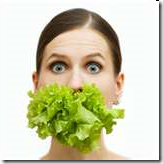
 Do you struggle to align your eating habits with your ideals? If you're like me, sometimes your taste buds take control and you find yourself eating something you know isn't the healthiest choice for your body and your spirit. In this post I want to address the timeless question of whether or not to be a vegetarian. At this moment in history where the environmental impact of every one of our choices, especially the 3-times-a-day ones, is so critical, it's important to examine how we choose what we eat. The decision affects our health, the environment, the economy, and global society. Personally, I am the kind of person who needs to gather a lot of information from many different traditions before I make big decisions. So I've compiled a surprising list of unusual theories about eating meat. If you're on the fence about becoming vegetarian or if you go back and forth, the following considerations and anecdotes may help you finally decide what is best for you.
Ayurveda is Vegetarian and Chinese Medicine Isn't
Ayurveda is part of the ancient Vedic tradition in India that believes that the highest purpose of human life is to attain spiritual enlightenment. Meditation is one of the primary paths to this goal, and all dietary and lifestyle recommendations support this. Ayurveda and yoga philosophy teach that eating meat brings a very dense, heavy, and agitating energy into the body that disturbs the mind and makes meditation and spiritual clarity very difficult.
Taking an animal's life also has karmic repercussions, so it is avoided as much as possible, especially in one's diet. Practicing non-violence is paramount in eating and living. Since the cow is sacred to Hindus, dairy products are highly valued and used frequently. Ayurvedic cooking emphasizes legumes and dairy products as the primary sources of protein to maintain good health.
In my first semester at acupuncture college, there were about 8 of us that were vegetarian. Within a few weeks of Chinese Medicine nutrition class, I was the only one left who was not eating meat. Chinese Medicine teaches that animal protein is crucial for building strong Qi and blood. Healthy Qi and blood are necessary for all the organs and systems to function well. Chinese herbal medicine contains many exotic animal ingredients considered to be highly rejuvenating and strengthening. Looking at ancient Chinese culture where the majority of the population was very poor and undernourished, it is easy to understand why animal protein would be considered so valuable. As far as I can tell, the emphasis on animal protein remains in the modern practice of Chinese medicine still.
How Tibetan Buddhism Explains Eating Meat
 A few years ago I attended a weekend of dharma teachings with Namkhai Norbu Rinpoche, an incredible Tibetan Buddhist teacher in the Dzogchen tradition. The grand finale of the weekend was a traditional feast involving alcohol and lots of meat. Tibetan Buddhism contains many tantric traditions which appear one way on the surface, but are actually very mystical and complex behind the scenes. This feast was like that. Extensive prayer and ceremony was performed in order to transmute the energy of the animals who gave their life so that they would benefit and attain a higher rebirth the next time around. Although I had the utmost respect for Rinpoche and the tradition behind the feast, I knew I couldn't actually eat the meat so I left before it started.
Given that Tibet is an extremely harsh, high altitude environment, it is not surprising that their culture evolved with meat in their diet. A Tibetan lama once told me that even though there is some negative karma involved in eating meat, they need it in their environment for their health, and so they pray for the animals and try to balance the action with other good deeds.
Why I Flip-Flopped
I became vegetarian in college mainly for political and environmental reasons. I didn't want to support the political and economic structures that devoted land and energy to mass factory farming of animals for human consumption. Ethically, I felt strongly that I didn't want to contribute to causing harm to other living beings. For over 15 years I was strictly vegetarian and always felt totally good about it.
After my first son was born, I was beyond exhausted from nursing and an extreme lack of sleep. One morning I woke up and the bacon smelled good. I thought that maybe I should heed the advice from acupuncture school and try to boost my vitality by eating some meat. Just to try it to see how I'd feel. Like an experiment. We started buying locally raised organic meat at our farmers' market and eating it a few times a week.
On one level I did feel more energetic. That winter I wasn't nearly as cold while skiing as I usually was. The main perk was the abundance of choices I now had when ordering food at restaurants. My carnivorous husband was very happy that I was now cooking meat and allowing it in the kitchen. But all along during the year that I was eating meat, I knew that I was operating in denial. I was denying the ethical and spiritual conflict that I'd had with eating animals in the first place. So I went back to being vegetarian and feeling right in alignment with my principles and values.
The Tsunami of 2004
This week on NPR they covered the Boston Vegetarian Society and interviewed several people who explained their personal reasons for being vegetarian. There were lots of familiar points: the environmental impact of mass cattle farming and it's contribution to global warming, the political and ethical incorrectness of livestock conditions on factory farms, and personal health benefits of being vegetarian. One man made a point that was especially poignant and different. He described how when the tsunami hit Southeast Asia in 2004, most animals ran inland well before it hit and avoided being destroyed. That made him question what we really know about what animals think and feel. He thought, maybe we don't understand animals at all. Maybe we've totally underestimated their role on the planet and their purpose among humans. I started thinking about how each person who becomes vegetarian has their own reasons for doing it. Some are common to thousands of people, and some are unique to a few.
Hunting For Food
 A lot of people argue that if you're going to eat meat you should hunt it and kill it yourself. They point out that hunting is an environmentally and politically friendlier way to obtain meat. Certainly that is the traditional way to provide meat for your family, and most tribal cultures still do it that way. Humans (except for Hindus, Jains, and most Buddhists) have always hunted for food. True enough. However ceremony was also an integral part of the taking of life for food. The sacrifice was acknowledged and genuinely appreciated. That gratitude has been totally lost in our modern culture.
I agree that if you're going to eat meat you should be able to kill it yourself in good conscience. Most people who eat meat are totally removed from the process and buy it in clean, plastic wrapped packages that don't reveal any animal origin whatsoever. We should know where our food comes from. We should be connected to our food. If you can face the animal and are ok with taking its life for food, then it's right for you. If you're not able to accept that reality, your mind will be more at peace being vegetarian.
Having A Choice
Personally I could never do it. I could never kill an animal to eat it, unless I was starving, which I'm not thankfully. Given that scenario, I'm sure I'd do whatever I had to in order to survive. Sure I've squashed ants and spiders and you can say there's no difference and there probably isn't. I am accruing negative karma for taking the life of these creatures. With food, however, I have so many choices. I can easily and happily eat all day long without taking the life of another living being. (OK, there might be aphids on my broccoli that die while cooking.)
For me it's a matter of having choices. Some people don't have a choice, so they eat animals. Maybe they have no access to vegetables. Some people have a health condition like diabetes or heart disease that undoubtedly improves on a vegetarian diet, so they choose to avoid meat. Each of us makes a choice that has an impact on the whole world. Choosing organic reduces global pesticide use and production. Choosing fresh local produce reduces energy use and supports local agriculture. Choosing to be vegetarian means that I am personally not contributing to the suffering of animals. We each make these powerful choices every day.
What do you choose to eat and why? Leave a comment below to continue the conversation.


 1:54 AM
 Vegetarian


 Posted in:


